
2026 in deals, and what 2027 looks like

Equity only, excluding debt, grants and post-IPO funding.
WHAT ACTUALLY HAPPENED
- Energy security became the climate agenda. The Strait of Hormuz closed in late February 2026 and stayed effectively shut for most of the following five months, creating one of the largest supply disruptions in oil-market history according to the IEA*. India imports 88% of its crude and 41% of it came through the strait. Domestic clean energy is now as much an import-substitution strategy as a decarbonization one, and policy has started to reflect that.
- Capital and policy shifted into manufacturing. Solar cells and wafers, lithium-ion battery cells, rare-earth magnets and semiconductors all received dedicated schemes, budget support or import protection. The investable question is moving from who builds the asset to who makes the critical component.
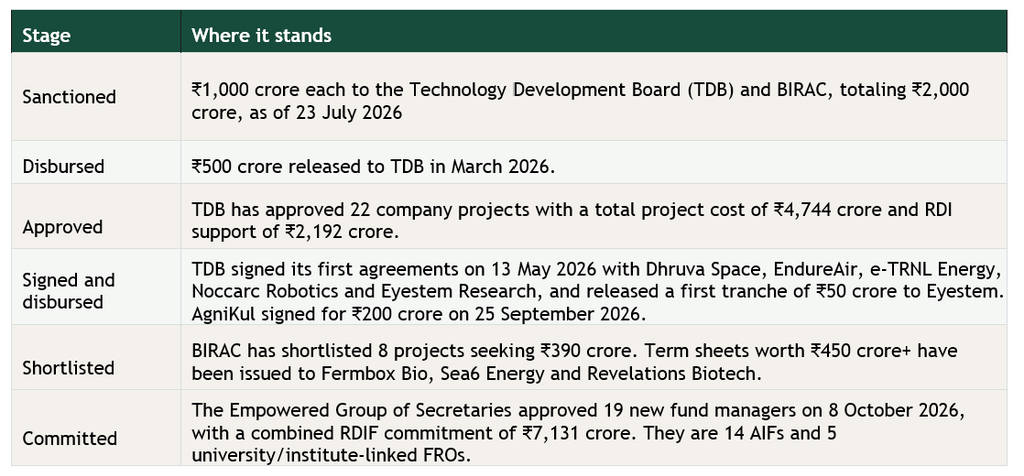
- The government entered the deep-tech capital stack. The Rs 1 lakh crore RDI Fund made its first disbursements in May 2026. By late July, the Technology Development Board had approved 22 projects and 162 alternative investment funds had applied to become fund managers. India has moved from enabling innovation to financing it.
- Rare earths became commercially strategic. China’s export controls in early-2025 left Indian EV manufacturers short of permanent magnets widely used in EVs. India answered with a Rs 7,280 crore magnet scheme, four rare-earth corridors and customs exemptions on processing equipment. Motors designed without rare earths moved from engineering curiosity to on-road commercial use.
- Debt grew faster than equity. Debt dominated new renewable-energy financing. JMK Research counts $4.8 billion into Indian renewables in Q2 2026: $2.8 billion debt, $530 million equity, and $1.4 billion M&A that changed ownership rather than funding new capacity.
- Equity became more focused. Indian climate-tech companies raised $2.6 billion across 302 funding rounds in 2025, averaging $8.6 million per round. Between January and May 2026, $791 million was raised across 74 rounds, taking the average to $10.7 million per round, around 24% higher. While the periods are not directly comparable, this suggests that funding is increasingly concentrated in fewer, larger transactions. Five late-stage rounds alone accounted for 71% of funding in 2026 YTD.
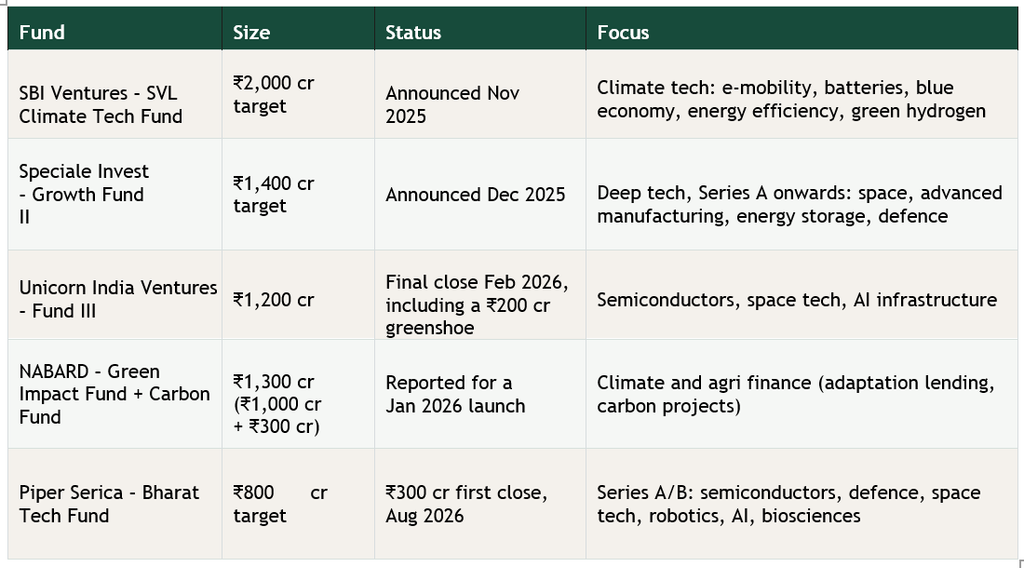
- Domestic growth capital started forming. Speciale Invest launched Growth Fund II, Piper Serica launched the Bharat Tech Fund, and Unicorn India Ventures closed Fund III, with SBI and NABARD among its institutional LPs to deepen India-domiciled capital for Series A to C-plus deep-tech companies. It is the thesis Ostara has believed in and solved for since 2015.
Prepared by Ostara Research. Data as at 11 September 2026. Research commentary, not investment advice.
1. Climate-tech Equity Funding
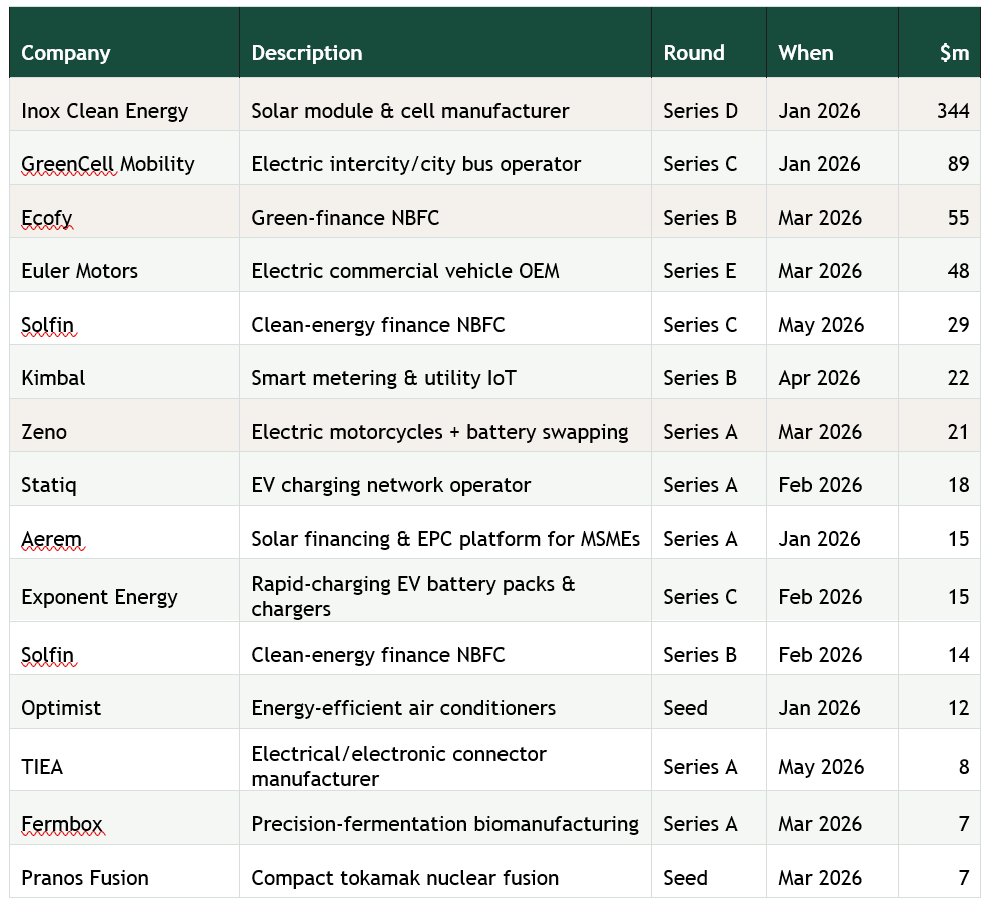
Indian climate-tech companies raised $791 million across 74 equity funding rounds during the 5 months of January to May 2026. However, the headline number masks a highly concentrated market. Five late-stage rounds accounted for $564 million, or 71% of total funding. These were:
- Inox Clean Energy: $344 million
- GreenCell Mobility: $89 million
- Ecofy: $54.7 million
- Euler Motors: $47.8 million
- Solfin: $28.9 million
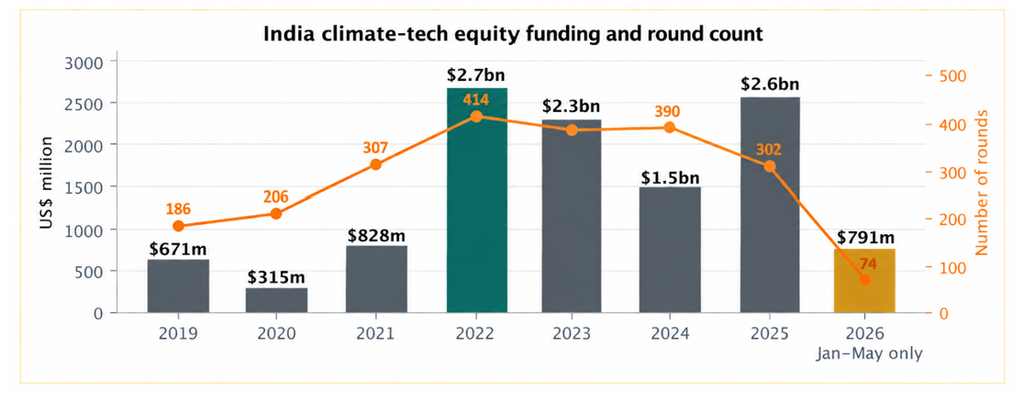
Equity only. Bars are dollars on the left axis; the line is round count on the right. 2026 covers 1 January to 31 May and is not annualized.
Indian climate-tech equity funding grew from $671 million in 2019 to an annualized $1.90 billion in 2026, implying a CAGR of approximately 16% over seven years. At the same time, the annualized number of funding rounds is estimated at 178 in 2026, compared with 186 in 2019, indicating that funding growth has been driven by larger average transactions rather than an increase in deal volume.
TAKEAWAY: Investor cheques are getting larger
The funding data points to a market that is becoming more concentrated, with capital increasingly flowing into fewer companies and larger transactions.
- Larger transactions are driving funding activity. Between January and May 2026, climate-tech companies raised $791 million across 74 rounds, averaging $10.7 million per round. Five late-stage rounds alone accounted for 71% of total funding, highlighting the growing importance of large investment cheques.
- Early-stage funding remains selective. During the same five-month period, companies raised $60.7 million across 44 seed rounds, while just 15 companies received funding for the first time.
- Full-year 2026 funding could reach $1.9 billion. If the January–May 2026 pace continues, annual funding could reach approximately $1.9 billion across 178 rounds. This is an indicative run-rate projection, not a forecast.
Where that capital goes, India against the world
India’s climate capital is concentrated in energy generation and materially under allocated to transport and buildings relative to the global market. That imbalance is likely to define the next phase of the transition.
Transport is a major investment opportunity to watch. Transport accounted for about 14% of India’s direct energy-related greenhouse-gas emissions in 2022, yet EVs represented only around 8% of new vehicle registrations in FY2025-26, against India’s target of 30% by 2030. Market forecasts projects India’s EV market to grow at a 41% CAGR between 2025 and 2030, reaching $152.2 billion. The scale of the transition will require capital well beyond vehicle manufacturing: NITI Aayog’s 2026 net-zero financing study estimates cumulative transport-sector mitigation-financing needs of $1.54 trillion by 2050, against projected available financing of $1.32 trillion, leaving a modelled $220 billion gap. This creates opportunities across charging and grid infrastructure, battery manufacturing and recycling, fleet electrification and financing, and zero-emission commercial vehicles.
2. Where the capital went
In 2026, capital flowed across six distinct value chains, each attracting a different kind of investor and financing structure. Renewable energy generation drew the largest cheques, largely through debt and public markets, while the solar and battery ecosystem attracted venture capital into the supply-chain gaps India still needs to fill. EVs shifted the focus from vehicles to components and infrastructure; mobility and cold chain demonstrated how climate solutions are becoming infrastructure businesses; specialised lenders financed adoption at the consumer and MSME level; and recycling emerged as a strategic critical-minerals opportunity rather than simply a waste-management story. The common thread is clear: India’s climate market is becoming more specialised, with capital increasingly following the specific bottlenecks in each value chain rather than treating climate tech as a single investment category.
Select Top Climate Private equity & VC rounds – January to May 2026
3. Energy independence, and what it is funding
For most of the last decade, India’s climate investment story was framed around emissions. In 2026, energy security and reducing import dependence became equally important parts of the investment case.
The disruption in the Strait of Hormuz made India’s exposure clear. The route carried roughly 40–50% of India’s crude imports, 55% of its LNG imports and 80–90% of its LPG imports; the disruption affected 55–60% of India’s LNG imports. India managed the immediate disruption through inventories, diversification and rerouting, rather than domestic supply.
The policy lesson was straightforward: diversifying imports reduces immediate risk, but building domestic alternatives reduces the underlying dependence. That shift is increasingly shaping what India is choosing to fund.
Biogas
Compressed biogas is emerging as a policy-backed investment opportunity. On 6 August 2026, the Union Cabinet approved GOBARdhan, a national circular bioenergy scheme with an outlay of ₹23,731 crore over FY2026-27 to FY2035-36. Capital assistance of up to ₹2 crore per tonne per day (TPD) of installed capacity for eligible greenfield projects, with brownfield expansions also covered, materially improves project economics and lowers upfront capital requirements. The scheme aims to unlock the value of agricultural residue, press mud, cattle dung and municipal organic waste by converting them into clean fuel and organic manure.
The bigger shift is towards bankable, infrastructure-like economics. The administered CBG procurement price has risen 43% to ₹2,110 per MMBTU, from ₹1,478, with a minimum ten-year pricing framework. Meanwhile, blending obligations for City Gas Distribution networks rose from 3% in FY2026-27 to 5% from FY2028-29, creating a stronger demand signal for producers. Combined with pipeline connectivity and credit guarantees for eligible MSME projects, these measures address critical barriers around capital, pricing, offtake and financing. For investors, this could make CBG an increasingly compelling long-term infrastructure opportunity, although returns will still depend on reliable feedstock supply, plant utilization and execution.
Domestic Manufacturing
The same logic is driving India’s push into solar cells and batteries.
India had 233 GW of Solar module capacity by June but only around 35 GW of listed domestic Solar cell capacity. The country has built substantial assembly capacity while remaining dependent on components further up the supply chain, including wafers, ingots and polysilicon.
Batteries present an even larger gap. 40 GWh has been awarded under the ACC PLI scheme, but only 1.4 GWh commissioned as of May 2026, while demand is projected to rise from 28 GWh in 2025 to 272 GWh by FY2030.
The next phase of India’s transition is increasingly about building what it currently imports.
Rare-Earth-Free Technology
China controls over 90% of global rare-earth magnet production, while India remains dependent on imports for sintered NdFeB magnets. China’s export restrictions exposed the vulnerability this created for Indian EV manufacturers.
The response is increasingly technological: design the dependency out.
Chara Technologies is building rare-earth-free synchronous reluctance motors. Ola has moved towards ferrite designs, while Conifer, Viridian Ingni Propulsion and Vimag Labs are developing alternative motor technologies.
The commercial calculation has changed: supply-chain resilience is increasingly part of the product’s value proposition.
Recycling and Critical Minerals
Recycling is becoming a strategic part of the same story.
India cannot build mines and refineries quickly enough to meet near-term demand for battery materials. Recovering lithium, cobalt and nickel from used batteries is therefore one of the few domestic supply sources that can scale in the shorter term.
ACE Green Recycling, Lohum, BatX and Recyclekaro all attracted capital during the year. Lohum’s move into rare-earth magnet production is particularly significant, extending the role of recycling from waste management to domestic materials supply.
For India, recycling is increasingly about resource security, not just waste.
Financing the Transition
The domestic transition also needs a financing layer. Ecofy, Solfin and Aerem raised capital to finance clean-energy and EV adoption among consumers and MSMEs, while development finance institutions continued to support the market where domestic growth capital remains limited.
The transition requires capital across the entire chain: manufacturing capital to build technologies, project finance to deploy them and financing capital to make them affordable.
4. Policy that changes how a deal gets underwritten
The RDI Fund is now live capital
The Research, Development and Innovation Scheme commits Rs 1 lakh crore (US$10 billion) over six years, with Rs 20,000 crore (US$2 billion) allocated in the FY2025-26 Budget. It is not a grant programme. The Anusandhan National Research Foundation (ANRF) passes capital to second-level fund managers who deploy it as low-interest loans, equity or a mix.
Critical minerals and rare earths
The fastest-moving industrial policy of the year, and it barely registered in climate coverage. The National Critical Mineral Mission carries an outlay of Rs 34,300 crore over seven years. The scheme for sintered rare-earth permanent magnets commits Rs 7,280 crore for 6,000 tonnes a year of integrated capacity across up to five beneficiaries. The Union Budget 2026-27 added dedicated Rare Earth Corridors in Odisha, Kerala, Andhra Pradesh and Tamil Nadu. Forty-six blocks have been auctioned, seven of them with rare-earth resources.
India holds around 7.23 million tonnes of rare-earth reserves, third largest in the world, and produces almost no magnets. Deal data here is still thin, and the most visible private move came from a battery recycler rather than a miner. That tells you where the entry point is.
Other Important Policies
Energy Storage is moving from a supporting technology to a core part of the power system. The second BESS viability-gap funding tranche provides Rs 5,400 crore for 30 GWh of storage, taking cumulative VGF support to about ₹9,160 crore across approximately 43.8 GWh. As four-hour storage becomes the procurement standard, the investment question is increasingly not how much renewable power can be generated, but whether it can be stored and delivered when demand requires it.
Carbon enters a critical test phase. India’s Carbon Credit Trading Scheme has imposed binding obligations on around 490 industrial units across seven sectors since April 2025, and the first exchange trades of Carbon Credit Certificates were expected in October 2026. The first round of price discovery will show whether compliance carbon becomes a functioning market or remains primarily a reporting mechanism.
Green hydrogen has policy support ahead of proven economics. The National Green Hydrogen Mission has an outlay of Rs 19,744 crore, with 3,000 MW of electrolyser capacity and 862,000 tonnes of annual production already awarded. The opportunity, however, is likely to be concentrated in projects with contracted demand, particularly in refineries and fertilisers, rather than speculative merchant production.
Nuclear is opening gradually to private participation. The SHANTI Act, 2025 allows licensed private operators, with foreign investment capped at 49%. Draft rules were issued in August 2026. Near-term expansion remains state-led, with capacity planned to rise from 8.78 GW to 22.38 GW by 2031-32 through NPCIL projects. As the policy framework evolves, clarity on tariffs, FDI norms and licensing is expected to unlock further opportunities in a strategically important sector with significant long-term investment potential.
Finally, India’s AI and data-centre build-out is creating a new source of climate infrastructure demand. Gujarat is targeting 7.5 GW of hyperscale green AI capacity and Uttar Pradesh a further 2 GW, while the Union Budget 2026-27 introduced a 20-year tax holiday for foreign cloud providers. The most investable opportunities are likely to sit upstream, in the infrastructure required to support this expansion: firm renewable power, energy storage, grid equipment, cooling technologies and water infrastructure.
The common theme is that India’s next climate opportunities are increasingly being created by system-level demand. Storage supports renewable power, carbon markets put a price on industrial emissions, hydrogen addresses hard-to-abate sectors, nuclear provides firm clean power and data centres create an entirely new source of electricity and infrastructure demand.
5. What 2027 holds
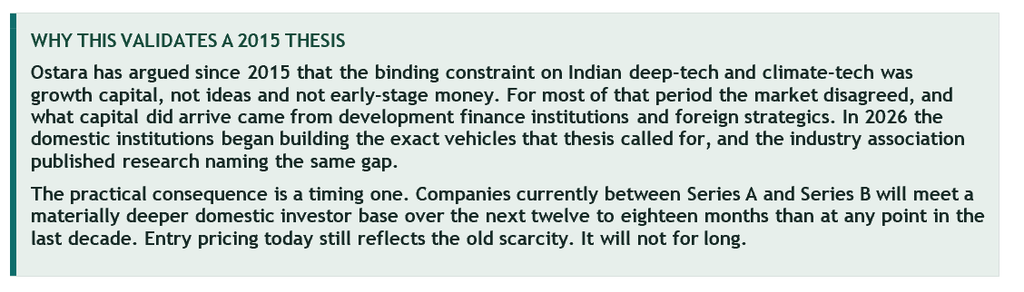
Domestic growth capital finally shows up
This is the most consequential thing happening and it is barely being discussed. IVCA puts cumulative Indian deep-tech investment at $11.4bn between 2015 and mid-2026, with 2025 the record year at $2.9bn across 189 rounds. It also identifies the structural problem directly: fund participation drops sharply at Series B and C, and 62% of surveyed funds name exit visibility as their primary constraint.
The response is now visible in fund formation. Every vehicle below is India-domiciled, aimed at growth or late-early stage, and announced or closed within the last twelve months.
Where the capital goes
Four areas stand out for 2027. Deep tech comes first, with Tracxn recording $2.22 billion across 179 rounds for January to August 2026 for deep tech companies, compared with $861 million across 287 rounds in the same period of 2025, indicating substantially more capital flowing into deep tech companies.
Energy Storage comes second, driven by a clear system need and explicit government support.
Green asset financing is third, sitting at the point where climate deployment meets the retail and MSME borrower, where demand for distributed-project debt remains substantially unmet.
Energy-efficient data-centre infrastructure is fourth, where the strongest opportunities are likely to sit upstream in power, storage, cooling and water rather than in the data centres themselves. Capacity forecasts vary widely, from JLL’s estimate of 1.6 GW in mid-2026 rising to 6 GW by 2029 to Wood Mackenzie’s projection of 2.2 GW in 2025 reaching 12 GW by 2030. The range itself reflects the uncertainty around the pace of build-out, while water availability, particularly in Tamil Nadu and Karnataka, remains one of the most underappreciated constraints.
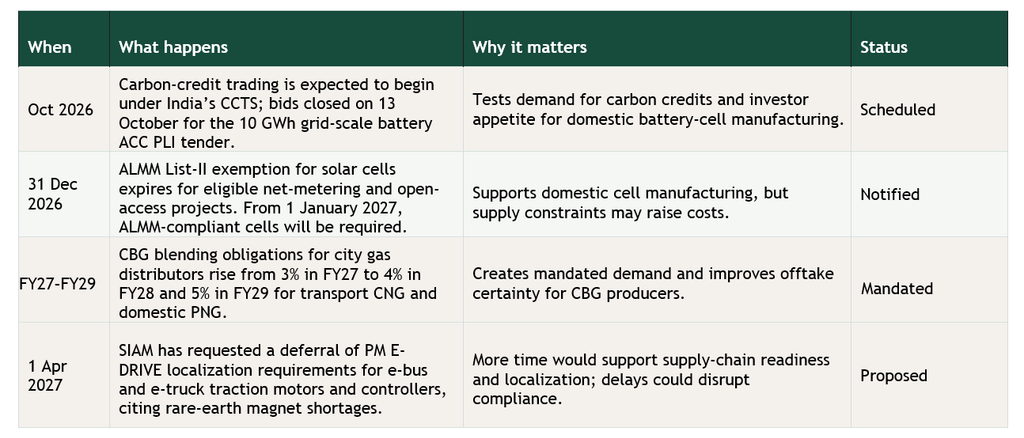
Dates that matter
Disclaimer:
Venture equity is the most visible part of India’s climate-finance market, but it represents only a fraction of the capital flowing into the transition. For a view of the full capital stack, the most useful benchmark is the Climate Policy Initiative’s Global Landscape of Climate Finance, which tracks primary climate-finance flows across public and private sources, domestic and international capital.
METHOD AND SOURCES
Scope. India-headquartered companies, or India-domiciled platforms for project finance. Deals are counted on announcement date, not close. Undisclosed rounds are counted in round counts and excluded from totals, so every total here is a floor. Rupee amounts convert at approximately Rs 88 to the dollar.
Figures are as at 11 September 2026, and later items are flagged as scheduled or requested.
Capital types are labelled and are not equivalent. A QIP is public-market equity, a PIPE is not a Series A, a debt closure may be a refinancing, and an acquisition price pays a seller rather than funding a target.
Principal sources. Tracxn, India Climate Tech 2026, for all equity funding, round counts, stage and investor data. JMK Research for renewable energy investment by instrument, solar capacity additions and EV registrations. Mercom for solar funding. BloombergNEF for energy transition investment. IEA, Congressional Research Service and Ministry of Petroleum briefings for Hormuz. PIB and Union Budget documents for GOBARdhan, the RDI Scheme and critical minerals. IVCA Bharat DeepTech Report 2026 for deep-tech totals and the Series B to C gap. Named company announcements and press reports for individual transactions, labelled in the deal table.
Nothing in this report is investment advice.