What if India’s biggest energy solution is sitting in its waste? A disruption in LPG supply can stall cities within days, exposing how fragile our energy system still is. As global tensions ripple through fuel supply chains, the question is no longer about access, but control.
Compressed biogas (CBG) offers a powerful answer: a domestic, scalable fuel built from India’s own waste, turning a structural vulnerability into a strategic advantage.
Compressed Biogas (CBG): From Waste to Pipeline-Ready Fuel
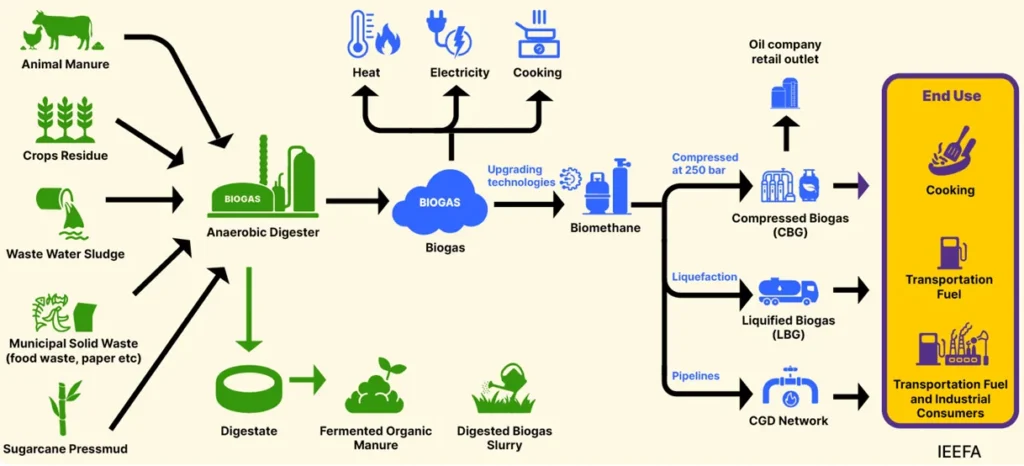
Compressed biogas (CBG) is a clean, renewable fuel made by converting organic waste into high-purity methane that can directly substitute natural gas. The process begins in an anaerobic digester, a sealed, oxygen-free system where microorganisms break down materials such as agricultural residue, animal manure, and food waste, releasing biogas, a mixture of methane, carbon dioxide, and trace impurities. This raw biogas is then upgraded by removing CO₂, hydrogen sulfide, and moisture to obtain biomethane with over 90% methane content.
The purified gas is subsequently compressed to form CBG. It can be used as a direct replacement for compressed natural gas (CNG) because both are primarily methane (CH₄), giving them similar energy content, combustion properties, and compatibility with existing vehicles, pipelines, and industrial systems. As a result, CBG functions as a drop-in, low-carbon alternative to fossil-based natural gas while also addressing waste management and methane emissions.
The below image shows the CBG value chain, where organic waste is converted into biogas, upgraded to biomethane, and used as fuel across cooking, transport, and industry.
Source: IEEFA
CBG Applications: Powering Cooking, Transport, Industry, and Agriculture
Cooking: Compressed biogas (CBG) can serve as a clean and reliable cooking fuel, particularly in rural and semi-urban India where households still rely on traditional biomass like firewood and dung cakes. Using biogas significantly reduces indoor air pollution, which is a major cause of respiratory illnesses and premature deaths. Decentralized household or community biogas plants can provide a steady, locally produced fuel source, reducing dependence on LPG and improving energy access.
Power: CBG can be used for decentralized power generation, especially in off-grid and rural settings. Biogas-based plants, ranging from small-scale units to larger installations, can generate electricity for farms, small industries, and communities. It is particularly effective in cogeneration systems, where both electricity and heat are produced, improving efficiency.
Transport: In the mobility sector, CBG acts as a direct substitute for compressed natural gas (CNG). Once purified and compressed, it can be used in natural gas vehicles, potentially reducing emissions by 60–80% compared to conventional fuels. It can be supplied through city gas distribution networks or transported to fuel stations, making it a scalable, low-carbon alternative for India’s transport sector.
Fertiliser: Beyond energy, CBG production generates a nutrient-rich by-product known as digestate, which can be used as organic fertiliser. It contains key nutrients like nitrogen, phosphorus, and potassium, improving soil health and reducing reliance on chemical fertilisers. Additionally, biomethane can be used as a feedstock for fertiliser plants, replacing imported natural gas and strengthening the circular economy.
India’s CBG Moment
India’s CBG opportunity sits at a rare intersection of massive, untapped supply and structurally guaranteed demand. Feedstock potential for CBG in India is both diversified and substantial, coming from agriculture, livestock, MSW, industrial waste, and dedicated energy crops. India’s total CBG potential is estimated at 40–60 MMTPA representing a $18bn market annually
On the demand side, policy is creating a clear scale-up pathway, with a mandatory CBG blending obligation rising from 1% in FY26 to 5% by FY29, alongside growing consumption across transport, industry, and city gas networks.
As a result, CBG production is expected to grow 7x+ by 2030, making it one of the fastest-scaling energy segments in India. With abundant feedstock and improving plant utilization unlocking further supply, India is uniquely positioned to build a large, domestic, and resilient gas economy around CBG.
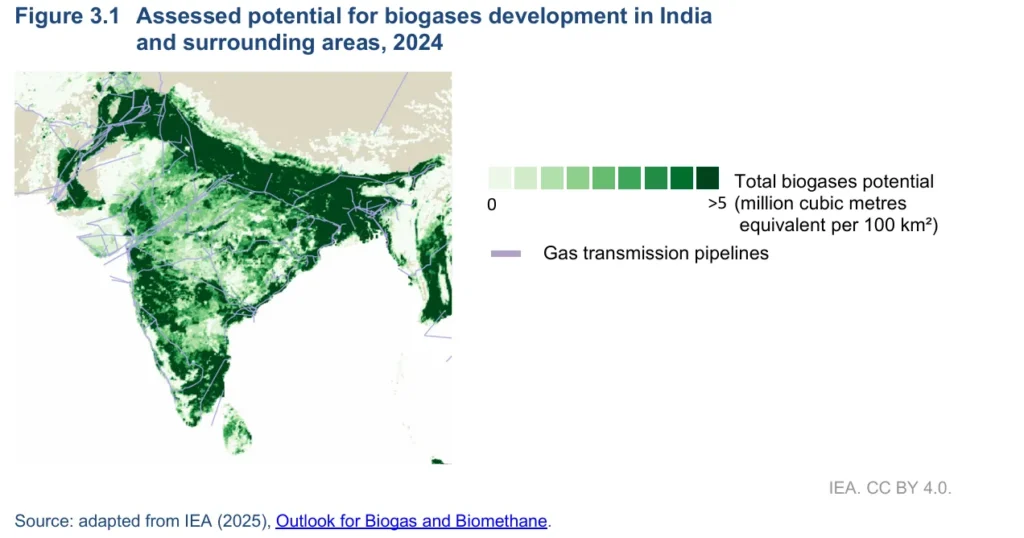
The map highlights that biogas potential is widely distributed across India, particularly in agriculturally dense regions, enabling decentralized and scalable CBG production close to demand centers.
Source: IEA
Key Policy Levers Driving CBG Scale-Up
Policy has moved from intent to structure: demand is now mandated, supply is subsidized, and economics are improving.
1. SATAT Scheme (2018)
- Flagship initiative to kickstart the CBG ecosystem
- Target: 5,000 plants and 15 MMTPA production
- Provides long-term offtake agreements with OMCs and pricing visibility
- Current status: 132 CBG plants
2. Compressed Biogas Obligation (CBO)
- Mandatory blending of CBG in CNG/PNG consumption
- Targets: 1% (FY26) → 3% → 4% → 5% (FY29 onwards)
- Creates guaranteed demand and offtake visibility for developers
3. Excise Duty Exemption on Blended CNG (Budget 2026-27)
- Eliminates double taxation on CBG blended with CNG
- Improves economics for CGD (City Gas Distribution) players
- Incentivizes higher blending levels through direct cost benefits
4. Central Financial Assistance (CFA)
- Capital subsidy under National Bioenergy Programme
- Up to ₹4 crore per 4,800 kg/day capacity, capped at ₹10 crore/project
- 20% higher support for North-East and hilly regions
- Reduces upfront capex burden
5. Pricing Support Mechanism
- CBG priced at 85% of average CNG retail price
- Ensures baseline revenue visibility for producers
6. Biomass Aggregation Machinery (BAM) Scheme
- Outlay: ₹5.64 billion (till FY27)
- Supports feedstock collection infrastructure
- Addresses one of the biggest bottlenecks: feedstock aggregation
7. CGD Synchronisation & Infrastructure Support
- Enables CBG injection into City Gas Distribution networks and transport via cascades
- Reduces logistics costs and improves market access
8. State-Level Incentives
- Includes VAT relief, capital subsidies, and policy support
- Critical for closing last-mile economics and accelerating adoption
The next phase of policy needs to shift from enabling capacity to ensuring execution, through stronger enforcement of blending mandates, state-level alignment, and faster CGD infrastructure expansion.
Equally critical is targeted support for feedstock supply chains and incentives to improve plant utilization, unlocking efficiency alongside scale.
Key Players Powering India’s CBG Ecosystem
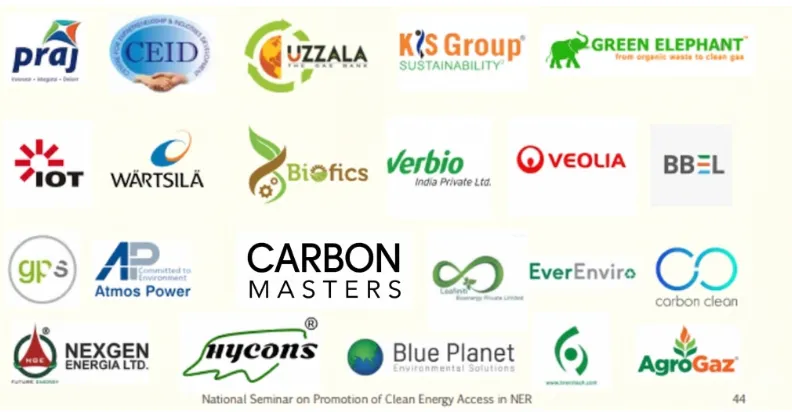
The above image illustrates some of the key players in the CBG ecosystem. EPC & Engineering players design, build, and supply equipment for CBG plants, this includes end-to-end plant engineering, technology integration, and construction, with companies like Praj Industries, Wärtsilä, IOT Infrastructure, Bright Biomethane Energy Limited, and Hycons. Project Developers/IPPs, on the other hand, own, finance, and operate CBG plants, driving capacity addition and revenue generation through gas sales; key players include Carbon Masters, GPS Renewables, EverEnviro, KS Group, Verbio India, Nexgen Energia, Atmos Power, Leafinit Bioenergy, and CEID Consultants and Engineering Pvt Ltd.
Feedstock & Waste Management players ensure consistent supply and processing of organic waste, which is the critical input for CBG production. They handle aggregation, logistics, preprocessing, and sometimes conversion, with companies such as Veolia, Uzzala, Green Elephant, Blue Planet Environmental Solutions, and AgroGaz. Lastly, Biogas Technology & Carbon Capture players provide specialised technologies that improve plant efficiency and monetisation, such as anaerobic digestion optimisation and CO₂ capture from biogas upgrading. This category includes Biofics and Carbon Clean, whose role becomes increasingly important as operators optimise yields and unlock additional revenue streams beyond just gas production.
Ostara in the News
1. Our founder, Vasudha Madhavan, was recently featured on NDTV, where she shared insights on India’s energy transition and the strategic importance of nuclear power.In the discussion, she highlighted the significance of achieving criticality at Kalpakkam as a milestone for India’s long-term energy security and independence.Check out the video below.
2. Vasudha was quoted in The Economic Times on 7 March 2026, highlighting that the climate transition requires diverse leadership, with significant opportunity for women to shape how capital, technology, and policy converge to build the next generation of sustainable businesses.Read the article here.
3. In her interview published in Outlook Business on 3 March 2026, Vasudha highlighted how persistence and ecosystem support can accelerate India’s climate-tech transformation, while emphasizing the growing role of women in clean energy, climate finance, and sustainable innovation.Check it out here.
4. Vasudha was featured in Deccan Herald on 27 March 2026, in an article examining the shift in venture capital focus toward energy-tech and climate-tech startups, reflecting evolving investor priorities toward scalable, sustainability-driven solutions.Read the article here.
5. Vasudha was quoted in The Tribune India on 8 March 2026, noting that more women entrepreneurs and investors are entering climate-focused sectors and helping drive solutions for a low-carbon economy.Read the article here.