Aviation has long been the symbol of global progress: connecting economies, people, and ideas across borders. But it also carries a heavy carbon cost.
Aviation may emit only about 2.5% of global CO₂, but its real climate footprint is far larger. When you factor in the extra warming from contrails (ice-crystal trails that trap heat) and NOx (nitrogen oxides that create heat-trapping ozone in the lower atmosphere), aviation’s total impact rises to roughly 3.5 – 4% of all global warming to date. And with global passenger numbers projected to reach 8 billion by 2040, this footprint could grow dramatically—potentially tripling emissions if the industry continues on a business-as-usual path.
Hydrogen and electric aircraft hold promise for the distant future, but for now, the only scalable, drop-in solution available is Sustainable Aviation Fuel (SAF), a cleaner, renewable alternative that can cut lifecycle emissions by up to 80% while using the same aircraft and infrastructure that already power global aviation.
The year 2025 marks an inflection point. With blending mandates now active in the EU and UK, and over 60 airlines pledging 10% SAF use by 2030, the race to decarbonize the skies has truly begun. For India, which consumes over 8 million tonnes of jet fuel annually and plans to double passenger traffic this decade, this is more than a climate imperative, it is a strategic opportunity to position the country as a global leader in green aviation.
Note: India’s aviation fuel landscape involves three separate quantities—ATF demand (total jet fuel use), SAF demand (based on blending requirements), and SAF production potential (maximum output from domestic feedstocks); these figures refer to different baselines and should not be compared directly.
What Is SAF and Why It Matters
Sustainable Aviation Fuel (SAF) is a drop-in replacement for conventional jet fuel made from renewable or waste-based sources such as used cooking oil (UCO), agricultural residues, municipal waste, or captured CO₂ combined with green hydrogen. (See “How SAF is made” below)
Chemically identical to Jet fuel, SAF works in existing aircraft engines and fueling systems without modification. Over its lifecycle, it can reduce emissions by up to 80%, since it reuses carbon already in circulation rather than releasing new fossil carbon.
Global Momentum and Blending Limits
Momentum is building fast. SAF output doubled between 2023 and 2024 to about 1 million tonnes, while 60 airlines now target 10% SAF use by 2030. The EU’s ReFuelEU Aviation and UK SAF mandates, launched in 2025, mark the first binding global blending requirements.
For India, the opportunity is transformative. The country produces over 3 million tonnes of UCO annually and plans a 1% SAF blend by 2027 and 2% by 2028. With its abundant feedstock and refining capacity, India could make 8–10 million tonnes of SAF per year, exceeding domestic demand and emerging as a supplier to Europe and the Middle East.
Although Sustainable Aviation Fuel (SAF) is chemically similar to conventional jet fuel, it must currently be blended, up to 50% with fossil Jet fuel because of aviation safety and certification limits.
Pure SAF currently lacks the aromatic compounds needed to maintain engine seal integrity and ensure optimal combustion, which is why international standards such as ASTM D7566 require it to be blended with conventional jet fuel until further certification is achieved. As the industry works through these technical and regulatory hurdles, both Boeing and Airbus have set targets to enable 100% SAF-powered flights by 2030.
The below diagram shows global SAF production capacity and demand.
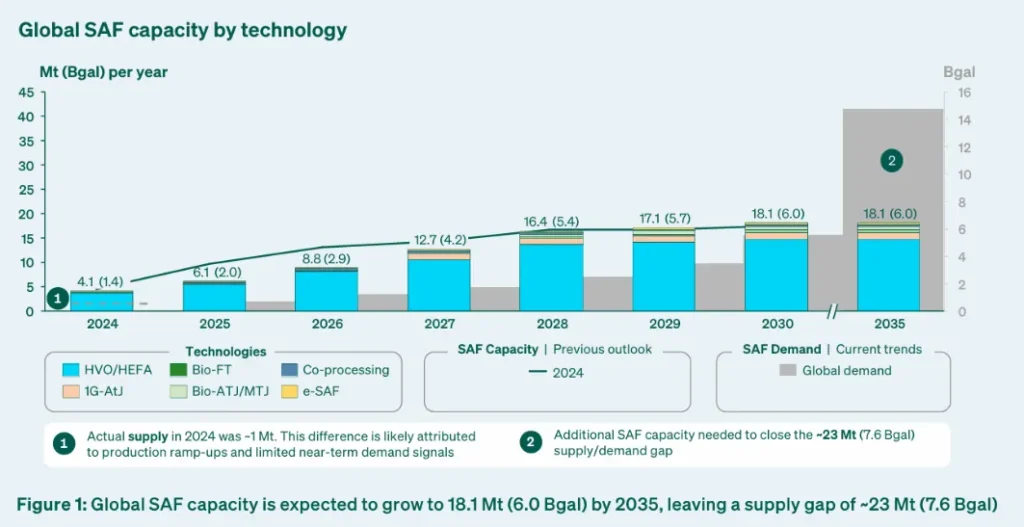
Source: SAF Outlook 2025
The Problem: Jet Fuel’s Carbon Burden
Every tonne of conventional jet fuel burned emits about 3.15 tonnes of CO₂. With global air traffic projected to reach more than 8 billion passengers by 2040, aviation’s share of emissions could rise sharply, even as other sectors decarbonize faster.
In India alone, Aviation Turbine Fuel (ATF) demand is expected to climb from 8.2 million tonnes in 2024 to 15–16 million tonnes by 2030. Meanwhile, the government’s strong EV push for road transport will make aviation one of the largest remaining carbon sources in India’s mobility mix by 2030.
Without a viable alternative like SAF, airlines risk facing both rising carbon costs (through mechanisms such as CORSIA) and growing pressure from corporate sustainability mandates.
The below image shows how SAF is the main decarbonization lever for aviation across all three different global decarbonisation pathways for aviation, created by the three major aviation bodies:
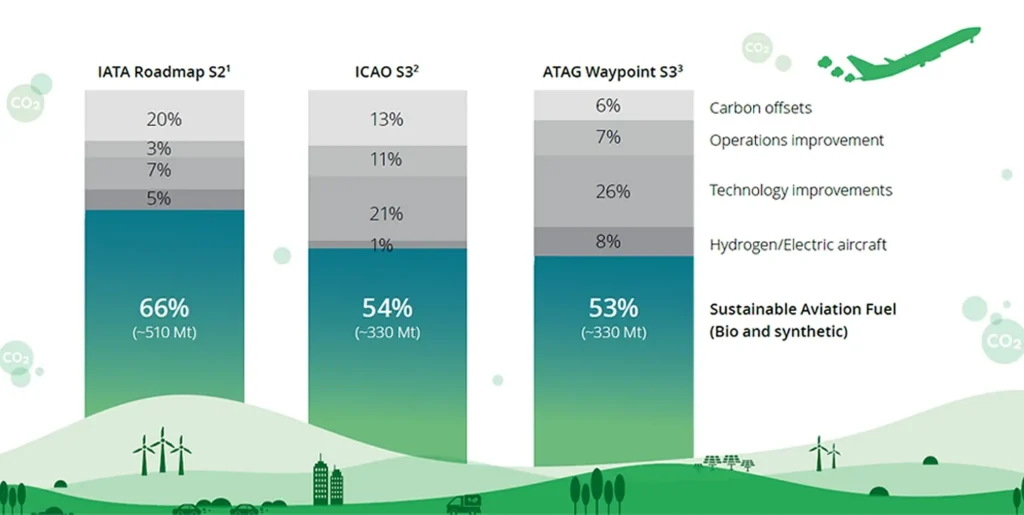
Source: Deloitte Green Wings Report
How SAF Is Made: Feedstocks & Pathways
Sustainable Aviation Fuel (SAF) can be made from a variety of renewable raw materials (feedstocks) such as used cooking oil, plant or animal fats, agricultural residues, municipal waste, or even captured carbon. These materials are suitable because they are rich in carbon and hydrogen: the same basic elements found in fossil fuels, allowing them to be chemically converted into hydrocarbons identical to jet fuel.
Feedstocks like used cooking oil and waste fats are popular for early SAF production since they are readily available and have a well-established supply chain. Agricultural and forestry residues provide a scalable, non-food alternative that can utilize existing biomass waste.
Municipal solid waste and captured CO₂ combined with green hydrogen represent the next frontier, turning urban and industrial emissions into a circular, low-carbon fuel source. Through advanced refining and chemical processing, these feedstocks are transformed into drop-in jet fuel that performs exactly like conventional aviation fuel, but with a much smaller carbon footprint. The process typically involves three main steps:
- Feedstock preparation: Waste oils or biomass are cleaned and processed to remove impurities.
- Conversion: The feedstock is then chemically transformed into hydrocarbons through methods such as hydrotreating, gasification, or fermentation.
- Refining and blending: The resulting synthetic fuel is refined to meet aviation standards and then blended (up to 50%) with conventional jet fuel before use.
There are four major production pathways approved by the International Civil Aviation Organization (ICAO):
- HEFA (Hydroprocessed Esters & Fatty Acids): Converts used cooking oil and waste fats into jet fuel; the most mature and widely used process, making up 82% of global SAF capacity.
- AtJ (Alcohol-to-Jet): Converts ethanol or other alcohols into jet fuel, likely to grow fastest in India due to abundant ethanol supply.
- Fischer–Tropsch (FT): Turns municipal waste, biomass, or crop residues into synthetic fuels through gasification.
- Power-to-Liquid (PtL or e-SAF): Uses captured CO₂ and green hydrogen to create synthetic jet fuel, the cleanest option but also the most expensive.
The below diagram shows the production process for SAF:
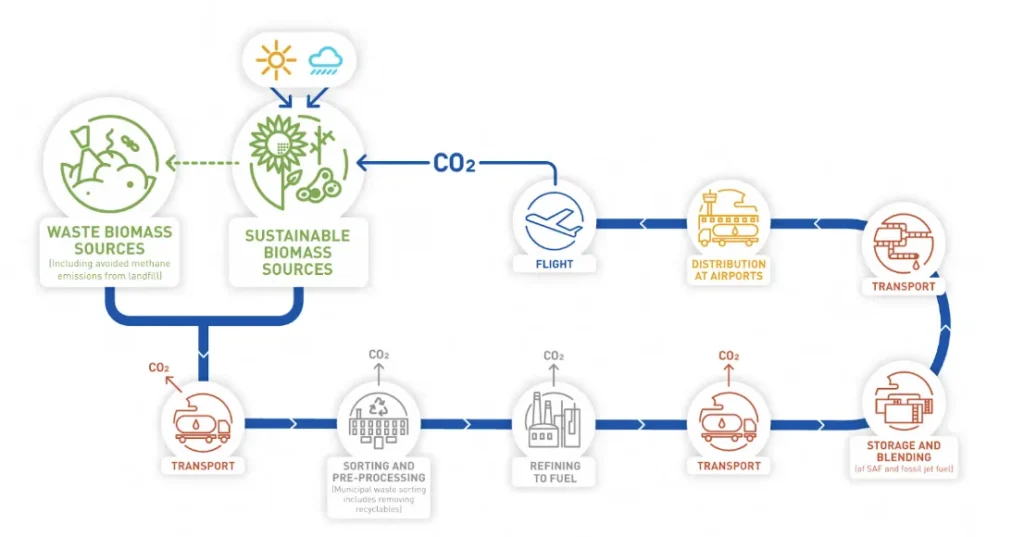
Source: Aviation benefits
Each pathway differs in cost and yield — for example, producing SAF from 1G ethanol costs roughly 2× the price of conventional jet fuel, while 2G ethanol can be up to 3.3× due to higher processing costs. However, costs are expected to decline as technologies scale and carbon pricing mechanisms strengthen.
According to Deloitte’s “Green Wings” report, India could produce 8–10 million tonnes of Sustainable Aviation Fuel (SAF) annually, exceeding its estimated domestic need of 4.5 million tonnes by 2040 (15% blend).
This production could generate: 1.1–1.4 million cumulative jobs across the value chain, $70–85 billion in capital investment, 10–15% additional income for farmers supplying agricultural residues, and $5–7 billion in annual oil import savings.
The government’s initial targets are a 1% SAF blend by 2027 and 2% by 2028 for international flights. Long-term success requires: a clear policy roadmap and incentives, organized feedstock supply chains (e.g., UCO under FSSAI’s RUCO), accelerated SAF certification and offtake agreements, and blending infrastructure at major airports.
If successful, India can become a global SAF hub, meeting its net-zero commitments while exporting to Europe and the Middle East.
Ostara in the News
1. In the October edition of ET Edge Insights, Ostara Advisors outlined how India’s climate-tech ecosystem is rapidly accelerating — and why the next phase demands specialised, scale-ready capital. The feature highlighted our role in driving growth-stage funding, connecting global investors with frontier Indian innovation, and enabling the transformative green technologies that will shape the country’s next decade of sustainable development.
Check out the magazine here: Link
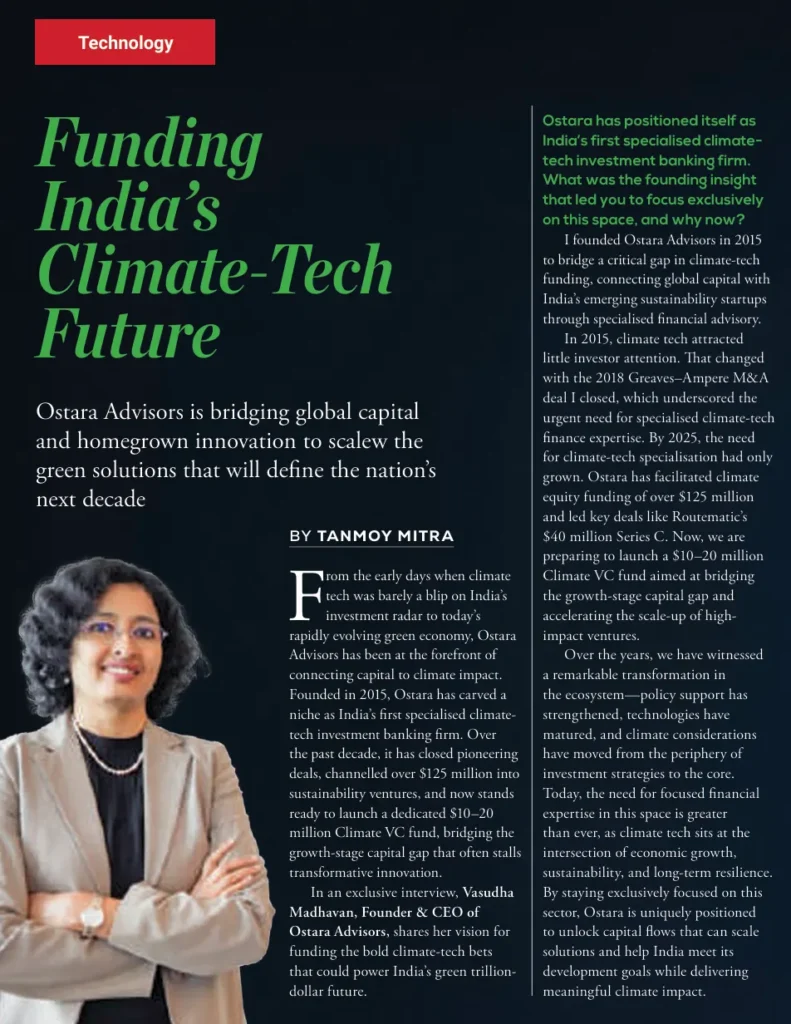
2. Our Founder, Vasudha Madhavan, authored a featured byline in YourStory that outlines what it truly takes to fund climate innovation, moving beyond returns to prioritise impact, resilience, and long-term climate leadership. Read the article here: Link

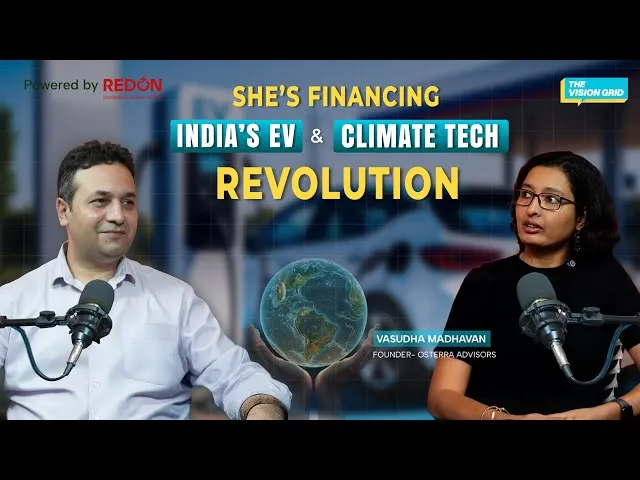
3. We were featured on the Vision Grid podcast, where Vasudha spoke with Sachin Agarwal about the key forces shaping India’s climate-tech and EV transition: rare-earth supply chains, battery innovation, sustainable AI, and the signals defining climate-tech funding.
Check out the podcast: Link
4. Vasudha was invited by the BRICS CCI Women Empowerment Vertical to speak on “The Sustainability Narrative” under the Global Women Leadership Programme 2025. Her perspectives on climate-tech, electric mobility, and green leadership inspired the cohort to think boldly about sustainability and responsible innovation.
Read more about it here: Link

5. Vasudha was invited as a speaker at Hindustan Times–VCCircle’s Next-Gen M&A & PE/VC Playbook 2025, where she shared insights on the rise of private credit, the role of Sovereign Wealth Funds and family offices, and emerging ESG-linked financing structures in India.
Read more on the event here: Link
6. As part of an ET Edge Insights Future Frontiers event on the global race for AI leadership, an expert panel was convened to examine how technological advances are reshaping geopolitics, power, and strategy. Vasudha participated as one of the speakers, offering insights on the intersections of technology, sustainability, and global policy.